Beneficial Owner Configuration Guide
Different countries have different legislation, and different obliged entities within the same country may choose to implement national legislation in different ways.
T-rank has a highly customizable approach to defining beneficial ownership. You may choose among several models; models can be combined and thresholds adjusted. You may even specify a cascading approach where model combinations are tried one by one until beneficial owners are identified.
For a more thorough review of T-rank's recommendations regarding the choice of calculation methods, see our white paper.
Models
Integrated ownership (integrated)
Integrated ownership is sometimes referred to as Effective ownership, Indirect ownership or Cash rights. It is the sum of any direct shareholding and indirect shareholdings an entity has in another, also taking any circular ownership into account.
Beneficial owners are most commonly defined as the natural persons who ultimately own or control a customer. In T-rank's opinion, integrated ownership is the best way to measure the own part of this definition.
When calling the /v2/beneficial endpoint, this model is specified by
the name integrated. The corresponding threshold is specified in the
threshold_integrated parameter. Typical values are 25 (at least
25%) and >25 (more than 25%).
AMLR reference: This models covers half of Article 52.
| Example | |
|---|---|
| BO owns 40% * 70% = 28% in Customer1 and becomes a BO in this company. BO owns 15% + 40% * 30% = 27% in Customer2 and becomes BO here as well. At first glance, it looks like BO only owns 40% * 40% = 16% of Customer3, but because of the ownership circle through H2, Customer3 owns 50% of itself. This implies that the intergrated ownership BO has in Customer3 becomes 32%, and BO is beneficial owner of Customer3 as well. | 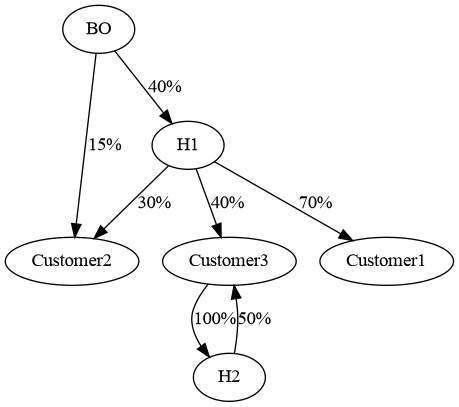 |
Integrated voting rights (integrated-vr)
Integrated-vr is calculated in the same way as integrated ownership, only that share of voting rights rather than share of shares (capital) is used as input.
In T-rank's opinion, applying the integrated ownership calculation principle on voting rights make little sense. If you are a 30% minority shareholder in a company owning 90% of the voting rights in a customer, you have no formal influence on decisions in the customer. If you own 90% of the voting rights in a company owning 30% of the voting rights in the customer, where the remaining voting rights in the customer is scattered among a high number of independent shareholders, you have next to control over the customer. The integrated voting rights is 27% in both examples.
When calling the /v2/beneficial endpoint, this model is specified by
the name integrated-vr. The corresponding threshold is specified in the
threshold_integrated_vr parameter. Typical values are 25 (at least
25%) and >25 (more than 25%).
For data sets where there is no distinction between ownership and voting rights, this model makes no sense and is unavailable.
AMLR reference: This models covers the other half of Article 52.
| Example | |
|---|---|
| In this example, the ownership (share of capital) differs from voting rights for the shareholders of Customer. BO has integrated ownership of 70% * 3% = 2.1% in Customer, while integrated voting rights is 70% * 40% = 28%. Thus, BO becomes BO according to the integrated voting rights model, but not according to the integrated ownership model. | 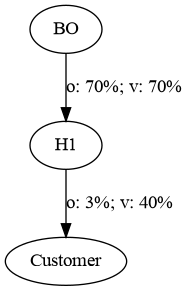 |
Voting Power (vp)
Voting Power is a (indirect) shareholders ability to influence the outcome of a vote at a general assembly. A shareholder with 100% voting power has complete control (is a majority shareholder). A shareholder with 50% voting power will be in a position to change the outcome of a vote in 50% of all possible voting combinations among the shareholders.
T-rank considers voting power to be the best way of defining Beneficial Ownership by means of influence in a company (the control part of the beneficial ownership definition).
When calling the /v2/beneficial endpoint, this model is specified by
the name vp. The corresponding threshold is specified in the
threshold_vp parameter. The default and recommended value for
threshold_vp is 49.8.
AMLR reference: Article 53. A threshold of 100% will limit to traditional control, a threshold close to 100% will include de facto control as defined in i.e. IFRS10. T-rank would argue that owners with voting power above 49.8% should be included due to their influence, and that this would be a more relevant model than integrated-vr.
| Example | |
|---|---|
| BO has marginal ownership in Customer (about 1.5%) but surprisingly high power. If he votes together with P3, they will have direct majority in Customer. If he votes together with either P1 or P2, he will win a vote in H1, and together with BOs direct 1% ownership in Customer, BO also become part of a majority coalition in Customer. Thus, BO is, by far, the most powerful shareholder (75% Voting Power) and a beneficial owner accoring to the Voting Power model. | 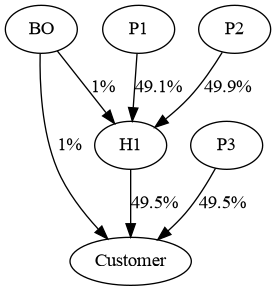 |
Ownership at Each Level (simcon)
This is a model used in some national legislations, stating that if there is more than a certain threshold of ownership or voting rights on each level between a natural person and a customer, the person should be considered a beneficial owner.
Clearly, if a person has some ownership in a company through a chain of minority shareholdings, that person will have no influence in the company, and the cash rights will become marginal. This is not a model recommended by T-rank.
The T-rank implementation of this model is a top-down recursive implementation. If a person has more than the threshold ownership in two companies, and these companies in sum have more than the threshold percent ownership in a third company, the person will be said to satisfy the model for the third company as well. We also adjust direct ownership for any circular self ownership not induced by the owner in question in the owned entity. For versions where we have both ownership and voting rights data, having more than the threshold percent of either voting rights or equity shares on each level will be sufficient.
When calling the /v2/beneficial endpoint, this model is specified by
the name simcon. The corresponding threshold is specified in the
threshold_simcon parameter. Only predefined values are supported for
threshold_simcon - see API sprecification for specifics.
AMLR reference: This model has no relevance for AMLR. For datasets where there is no distinction between voting rights and ownership, simcon with threshold >50% can be used for determining traditional control (Article 53).
| Example | |
|---|---|
| An ownership chain, with more than 25% at each level: At the top, the ownership (share of capital) is above 25%. At the next level, voting rights is above 25%. At the next level, there are two companies for which both the ownership and voting rights share is above 25%. When we sum the ownership these companies hold, the ownership in H5 also become above 25%. Finally, we reach the customer. | 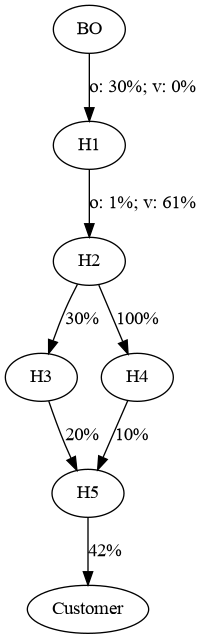 |
Control (control)
A person controlling a company becomes Beneficial Owner.
Control is defined by means of Voting Power, and how much voting power is needed for control may be specified in threshold_control and defaults to 99.9.
AMLR reference: This model covers Article 53.
| Example | |
|---|---|
| There is a chain of control from BO to the customer, thus BO is a beneficial owner in Customer based on the control model. Note that integrated voting rights is below the standard 25% threshold, illustratring the lack of conclusions that could be drawn based on that measure. | 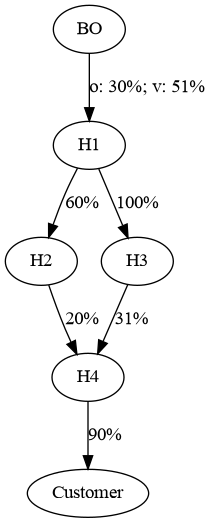 |
Control of Ownership (control+ownership)
If a person - either directly or through companies they control, holds more than the threshold percentage of shares or voting rights in a target company, they are considered a beneficial owner. This model prevents individuals from hiding ultimate control by scattering ownership across multiple holding companies.
When calling the /v2/beneficial endpoint, this model is specified by
the name control+ownership. The threshold for the share of voting
rights that must be controlled is specified in threshold_control_vr,
the share of the capital (shares) in
threshold_control_capital. Control is defined by means of voting
power, and applies the same threshold as the control model
(threshold_control).
AMLR reference: This model covers half of Article 54.
| Example | |
|---|---|
| BO is, in sum, controlling 30% of the ownership and voting rights in customer and thus becomes a beneficial owner throught the control of ownership model: 10% directly, 10% through the controlled company H1 and 10% through the controlled company H2. | 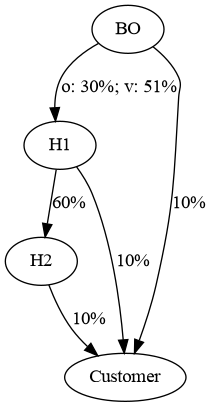 |
Ownership in mother (ownership+control)
In order for this model to yield any results, it must be combined with
the model(s) integrated and/or integrated-vr. Which of these two
models are active, and with what thresholds, determines the ownership
part of this model definition. The control part is resolved using
Voting Power, with the same threshold for control as the control
model (threshold_control). A person becomes beneficial owner in a
customer if the person 1) has sufficient ownership in a single company
to become beneficial owner in this company, and 2) this company
controls the customer. This model ensures that if a person is
beneficial owner in the mother of a corporate group, this person will
be BO in the entire group.
When calling the /v2/beneficial endpoint, this model is specified by
the name ownership+control. threshold_integrated and
threshold_integrated_vr are relevant for determining ownership,
threshold_control for determining control.
AMLR reference: This model covers the second half of Article 54.
| Example | |
|---|---|
| BO has sufficient ownership in Mother to become a beneficial owner in Mother according to the Integrated ownership model (40% * 40% + 10% = 26%). The model Ownership in mother then implies that BO is also a beneficial owner in the entire corporate group, which includes Sub1, Sub2, Sub3, Sub4 and Sub5 in addition to the Mother. | 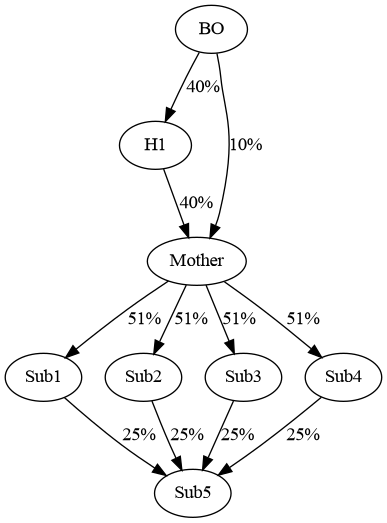 |
Beneficial Owner Registers (bo-register)
Note: Not available on all instances, check the specific API Reference.
When a person is registered as a beneficial owner in a national register, that person becomes beneficial owner.
In order to gain access to the Danish and Finnish BO registers, you must be an obliged entity. In order to gain access to the Norwegian BO register, you must have applied for and been given access to the register through The Brønnøysund Register Centre. You must also delegate this access to T-rank and notify T-rank about the delegation.
When calling the /v2/beneficial endpoint, this model is specified by
the name bo-register. If you also submit the parameter
include_combine_reg=true, BO registers and any other models you have
specified will be chained.
Norwegian Beneficial Owner Register Definition (ge50c-gt25)
Note: Not available on all instances, check the specific API Reference.
This model mimics the definition set forth in the Norwegian Beneficial Owner Register legislation. If a person - directly and through companies he/she controls - holds more than 25% of the shares or voting rights in the target company, he/she becomes a beneficial owner. Control is defined as having at least 50% of the voting rights at every step of the control chain.
When calling the /v2/beneficial endpoint, this model is specified by
the name ge50c-gt25.
Alternative BO (alternative-bo)
Note: Not available on all instances, check the specific API Reference.
A person having one of specified roles in the entity will be regarded as a beneficial owner. Note that this model is always active for foundations and trusts, regardless of which models you specify. Thus, this model is usually only specified as a fallback model when using a cascading approach.
When calling the /v2/beneficial endpoint, this model is specified by
the name alternative-bo. The parameter bo_roles can be used to specify a
comma-separated list of roles that will trigger beneficial ownership.
Combining Models
The model parameter in /v2/beneficial may contain a
comma-separated list of models, meaning that a person will become a
beneficial owner if he/she satisfies at least one of the listed
models.
Cascading Approach
Cascading approach means that the system should first try to find beneficial owners using one set of models. If none is found, try another set of models, and so on.
In /v2/beneficial, a cascading approach is specified by separating
each step in the sequence with colons.
Example:
model=vp,integrated:bo-register:role
First, check if there are any beneficial owners by applying the
Integrated ownership and Voting Power models. If none are found, look in
national beneficial owner registers. If still none are found, return the
CEO and Board of Directors.
Family Relations
Note: Only supported in the Tieto version and for people registered in the Norwegian Population Register. In order for this to work, the calling party must have extended access to the Norwegian Population Register, and must have delegated these rights to Tieto.
When turned on, the owners of the company will be checked against the
population register to determine whether they are close family
according to the Norwegian AML legislation, If they are, they will be
treated as a single unit when checking any of the models integrated,
vp, control, ownership+control and simcon. Note that for the
control model, simcon with threshold >50% is used for determining
control by families. When a set of close family members are found to
satisfy a model, all members (who have ownership in the company) will
be returned as beneficial owners.